 Penyewaan bank daya,Produsen bank daya bersama
Why Is Egypt a Growing Red Sea Tourism Market for Shared Power Banks?
Egypt’s opportunity for shared power bank businesses comes not only from urban commercial demand in Cairo, but also from the growing number of international tourists visiting resorts along the Red Sea coast. For investors planning to enter Egypt, choosing the right deployment locations is only part of the process. Product registration, wireless device certification, and local payment integration must also be addressed in advance.
The answer is Egypt. In 2025, Egypt welcomed approximately 19 million international tourists, representing year-on-year growth of around 20%–21% (Egyptian Ministry of Tourism and Antiquities, 2025). Meanwhile, airports across the country handled 58.94 million passengers (Egyptian civil aviation authorities, 2025), providing a steady potential user base for airports, Perbelanjaan, museums, and resort destinations.
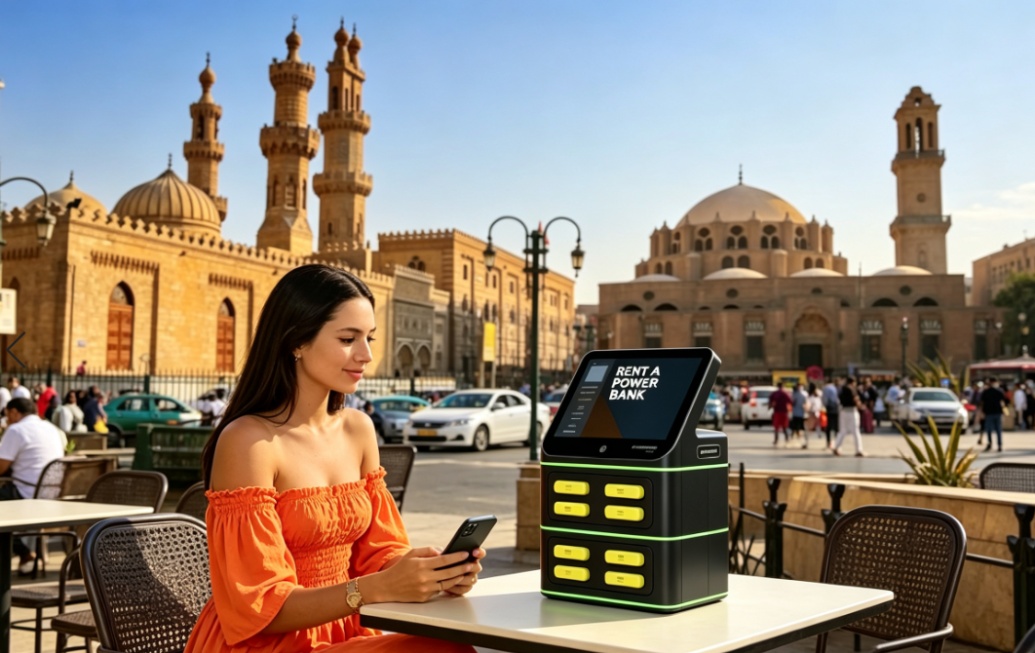
1. Egypt’s Shared Power Bank Market: 3 Key Advantages Worth Watching
Growing tourism traffic — Egypt welcomed approximately 19 million international tourists in 2025, while tourism revenue increased by 17% year on year (Egyptian Ministry of Tourism and Antiquities, 2025). Tourism-related consumption scenarios continue to expand.
A broad mobile device user base — Egypt had 121 million mobile connections dan 98.2 million internet users, with an internet penetration rate of 82.7% (DataReportal, Digital 2026: Egypt, 2025), indicating widespread use of mobile devices.
Developing local digital payments — InstaPay had 16 million users, while mobile wallets reached 55.5 million accounts (Central Bank of Egypt, CBE, 2024/2025 Annual Report, as of 2025), providing a digital payment foundation for unattended devices.
This article examines the market entry opportunities for shared power bank businesses in Egypt from four perspectives: GOEIC registration and NTRA type approval, InstaPay and bank card payments, deployment opportunities across Cairo and Hurghada, and project estimates based on the experience of Shenzhen Zhongdian Hexin’s Litapower brand.
2. Market Compliance: GOEIC Registration and NTRA Certification Are Essential Requirements for Entering Egypt
Shared power bank devices entering the Egyptian market need to follow two key compliance procedures: manufacturer or exporter registration overseen by the General Organization for Export and Import Control (GOEIC), and wireless device type approval administered by the National Telecommunications Regulatory Authority (NTRA).

Power banks contain lithium batteries and are subject to battery safety requirements. Smart charging stations may also contain Bluetooth, Wi-Fi, or cellular communication modules. Incomplete documentation can affect product inspections and customs clearance. Wireless devices without NTRA certification may also prevent the GOEIC inspection process from being completed.
2.1 Three Key Points About GOEIC and NTRA
① GOEIC registration — The General Organization for Export and Import Control (GOEIC) is responsible for relevant registration procedures for regulated electrical and electronic products in Egypt. Manufacturer or exporter registration takes approximately 5–15 working days, costs around US$300–800, and the certificate is valid for one year (GOEIC guidelines, 2026).
② NTRA type approval — Shared power bank stations and related devices containing Bluetooth, Wi-Fi, or cellular communication modules must obtain NTRA type approval. The process takes approximately 6–10 weeks, costs around US$1,000–2,500 per model, and the certificate is valid for five years. Overseas companies cannot apply directly and must appoint a local Egyptian representative (NTRA regulations, 2026).
③ Conformity documents for each shipment — GOEIC registration does not mean that every shipment can be dispatched without further procedures. Each shipment still requires a COI/CoC certificate of conformity. Inspection and certificate issuance take approximately 1–2 weeks, with testing costs of around US$1,500–3,000, excluding additional inspection fees (GOEIC guidelines, 2026).
2.2 Application Process for Bringing Equipment into Egypt
① Prepare technical documentation — Organize product manuals, circuit diagrams, bills of materials (BOM), test reports, IEC 62133 battery safety reports for power banks, and UN 38.3 transport test reports (relevant requirements of the Egyptian Organization for Standardization and Quality, EOS, 2026).
② Obtain wireless device certification — For equipment containing wireless communication modules, a local Egyptian representative assists with submitting documents to NTRA, arranging testing, and applying for type approval.
③ Complete GOEIC registration and shipment inspections — Complete manufacturer or exporter registration according to GOEIC requirements and prepare the relevant conformity documents before each shipment is dispatched.
④ Complete customs documentation checks — Product manuals and technical documents should be available in Arabic, and product labels should include information about the Egyptian importer (GOEIC guidelines, 2026).
2.3 Three Additional Requirements for Market Entry
(1) Battery safety and transportation — Power banks must comply with applicable Egyptian ES standards and IEC 62133 requirements. UN 38.3 test reports and MSDS documents should be prepared for transportation (relevant EOS and IATA DGR requirements, 2026).
(2) Offline commercial permits — Deploying self-service devices in shopping malls and public spaces requires commercial permits in accordance with local municipal regulations, as well as approval from the venue operator. The application process takes approximately 2–6 weeks (Egyptian municipal and venue practices, 2026).
(3) Commercial insurance — International hotels and shopping malls commonly require public liability insurance before allowing equipment installation. When purchasing insurance, operators should confirm whether the coverage includes lithium battery thermal runaway risks (industry practice, 2026).
All Litapower shared power bank stations and power banks from Shenzhen Zhongdian Hexin have obtained market access certifications including CCC, CE, FCC, and PSE. The batteries comply with the IEC 62133 safety standard for portable lithium batteries. The products also have CB (IECEE) mutual recognition test reports, meet RoHS hazardous substance restriction requirements, and are supplied with UN 38.3 transportation test reports.
3. Payment Ecosystem: Local Instant Payments and International Bank Cards Work Together to Cover Users
Egypt’s digital payment system is developing, and local users and international tourists have different payment habits. InstaPay is suitable for local users with Egyptian bank accounts, while bank cards and mobile wallets help cover a wider range of consumption scenarios. Shared power bank operators should prioritize local payment acquiring capabilities and a convenient payment experience for international visitors.
2.1 Three Characteristics of InstaPay and Local Digital Payments
① InstaPay user base — Egypt’s national instant payment network, InstaPay, had 16 million users, with approximately 1.1 billion cumulative transactions worth around EGP 2.4 trillion (Central Bank of Egypt, CBE, 2024/2025 Annual Report, as of June 2025). It is suitable for payment scenarios involving local bank account transfers, but tourists generally need an Egyptian bank account to use the service.
② Local bank card coverage — The Meeza national card network reached 43.5 million cards (Central Bank of Egypt, CBE, 2024/2025 Annual Report, 2025), providing a foundation for local debit and prepaid card payments. For shared power bank devices, card acceptance can serve users who do not use local instant bank transfers.
③ Mobile wallets and phone payments — Egypt had 55.5 million mobile wallet accounts, with approximately 1.4 billion transactions (Central Bank of Egypt, CBE, 2024/2025 Annual Report, 2025). Apple Pay launched in December 2024. By 2025, related transactions had reached 40 million, with a total value of approximately EGP 32 billion (Central Bank of Egypt, CBE, 2024/2025 Annual Report, 2025).
2.2 Recommended Payment Integration Solutions
Shared power bank projects in Egypt can prioritize a combination of local bank card acquiring + mobile wallets or instant payments + international bank cards and mobile payments. InstaPay can serve local bank account users, while international bank cards and Apple Pay can make payments more convenient for foreign tourists.
For actual integration, operators are advised to work with payment service providers that hold the appropriate local qualifications and licenses. Under the Central Bank of Egypt’s payment services regulatory framework, independently operating an acquiring business requires the relevant authorization. Card-reading terminals installed in charging stations should also meet applicable PCI-DSS requirements. Where users’ personal information is involved, operators should consider Egypt’s Personal Data Protection Law No. 151 arab 2020.
2.3 Litapower Payment Integration
For its shared power bank projects in Egypt, Shenzhen Zhongdian Hexin’s Litapower has worked with local operators to complete InstaPay payment integration, including interface adaptation and joint testing. Customers can independently select their payment service providers, with the customer’s own company serving as the contracting entity.
FAQ
Q1. How large is Egypt’s shared power bank market?
Demand for shared power bank projects in Egypt is mainly supported by tourism traffic, mobile device usage, and the development of digital payments. In 2025, Egypt welcomed approximately 19 million international tourists (Egyptian Ministry of Tourism and Antiquities, 2025). The country had 121 million mobile connections (DataReportal, Digital 2026: Egypt, 2025), alongside 98.2 million internet users and an internet penetration rate of 82.7%. InstaPay also had 16 million users (Central Bank of Egypt, CBE, 2024/2025 Annual Report, as of June 2025), providing a user base for online shared power bank rentals and payments.
Q2. What certifications or registrations are required to deploy shared power banks in Egypt?
Shared power bank equipment entering Egypt must primarily address GOEIC registration dan NTRA type approval. GOEIC registration takes approximately 5–15 working days, costs around US$300–800, and is valid for one year. Stations containing wireless modules must obtain NTRA type approval, which takes approximately 6–10 weeks, costs around US$1,000–2,500 per model, and is valid for five years (GOEIC guidelines and NTRA regulations, 2026). Each shipment also requires COI/CoC conformity documents, together with Arabic product manuals, IEC 62133 battery safety reports, and UN 38.3 transportation test reports.
Q3. What payment methods can local residents and tourists use to rent shared power banks in Egypt?
Local Egyptian users can pay through InstaPay, Meeza bank cards, and mobile wallets. InstaPay had 16 million users, mobile wallets reached 55.5 million accounts, and Meeza cards reached 43.5 million (Central Bank of Egypt, CBE, 2024/2025 Annual Report, 2025). International tourists are more likely to use international bank cards and Apple Pay. Since its launch, Apple Pay-related transactions have reached 40 million (Central Bank of Egypt, CBE, 2024/2025 Annual Report, 2025). Jadi, projects should support both local payment methods and payment options commonly used by international visitors.
Q4. How can investors build their own shared power bank brand in Egypt?
Local entrepreneurs and investors in Egypt can work with Chinese supply chains to develop their own shared power bank businesses through OEM private-label customization. They can operate under local brands and adapt their devices and software to local payment methods, languages, and user habits.
Shenzhen Zhongdian Hexin’s Litapower provides shared power bank OEM and private-label customization services. Customization can cover station appearance, brand logos, user interfaces, management backends, and API integration, helping customers establish independently operated brands.
Q5. How long does it take to recover the investment in an Egyptian shared power bank project?
Based on Shenzhen Zhongdian Hexin Litapower’s project experience in comparable Southeast Asian markets, the estimated payback period for an 8-slot station in Cairo is approximately 5–7 months, while an 8-slot station in Hurghada is estimated to take approximately 4–6 months.
The actual payback period depends on equipment procurement costs, venue revenue sharing, payment processing fees, rental pricing, and average daily orders. These figures are project estimates based on operating experience and do not represent the actual performance of an existing deployed project in Egypt.
References
- DataReportal, Digital 2026: Egypt: https://datareportal.com/reports/digital-2026-egypt
- Egyptian Ministry of Tourism and Antiquities: Egypt’s participation in the 60th Berlin Tourism Exchange: https://sis.gov.eg/zh/
- Egyptian Organization for Standardization and Quality (EOS), relevant certification information: https://www.wanve.net/en/certification/electronics/egypt
- Egyptian civil aviation authorities, 2025 airport passenger statistics: https://newsaero.info/en/article/airports/egypt-posts-record-5894-million-air-passengers-in-2025
- State Information Service (SIS), Egypt: https://sis.gov.eg
- Citystars Heliopolis official website: https://www.citystars-heliopolis.com.eg