 Penyewaan bank daya,Produsen bank daya bersama
The Cambodia shared power bank market is attracting new business opportunities. Although the country’s total tourist arrivals have fluctuated, the number of Chinese visitors is increasing, air arrivals are growing, and the Bakong digital payment system is becoming more established. As one of Southeast Asia’s promising tourism destinations, Cambodia relies heavily on its cultural and tourism industries and welcomes international visitors throughout the year. Its tropical climate and year-round high temperatures can accelerate smartphone battery consumption, while public charging facilities remain relatively limited. These factors create new opportunities for shared power bank deployment.
1. Changes in visitor demographics: Cambodia received 5.57 million international visitors in 2025, including approximately 1.2 million Chinese visitors, representing a year-on-year increase of 41.5% (Cambodia Ministry of Tourism, 2025).
2. An established local payment infrastructure: The Bakong system has approximately 4.5 million KHQR acceptance points and has established payment connections with systems in China and several other countries and regions (National Bank of Cambodia, NBC, 2025).
3. A clear equipment compliance pathway: Current TRC type approval procedures generally take around 6–8 weeks. Existing CE test reports may be used as supporting documents, subject to the applicable requirements (Telecommunication Regulator of Cambodia, TRC, 2025–2026).
This article examines market data, equipment certification, payment infrastructure, power compatibility, key city locations, and Zhongdian Hexin Litapower’s overseas solutions to explore opportunities for launching a Cambodia shared power bank project.
I. Cambodia Shared Power Bank Market: Four Key Figures
Opportunities in the Cambodia shared power bank market are not driven solely by tourist numbers. They also come from changing visitor demographics, growing mobile internet adoption, and the development of local digital payment infrastructure. For operators planning to enter Cambodia, it is important to identify where new consumer scenarios are emerging and which customer groups are most likely to adopt QR code rental services.

1.1 Population and Mobile Internet Infrastructure
Cambodia has a population of approximately 17.9 million, around 12 million internet users, and an internet penetration rate of 67.3%. The country has approximately 21.7 million mobile connections, equivalent to 121% of its population. Social media users number approximately 14 million, representing 77.9% of the population (DataReportal, Digital 2026: Cambodia, October 2025).
The number of mobile connections exceeding the population indicates widespread access to mobile communication devices. Smartphones are not only used for everyday communication but are increasingly important for social networking, navigation, online shopping, and mobile payments. Shared power banks can provide temporary charging services to meet these frequent mobile usage needs.
1.2 Inbound Tourism: Overall Adjustment and Growth in Chinese Visitors
Cambodia received 5.57 million international visitors in 2025, representing a year-on-year decrease of 16.9%. Visitors included approximately 1.22 million Vietnamese, 1.2 million Chinese, dan 1 million Thai tourists. The number of Chinese visitors increased by 41.5% (Cambodia Ministry of Tourism, 2025).
In terms of visitor demographics, China has become one of Cambodia’s important international source markets. Cambodia generated approximately USD 3.7 billion in international tourism revenue in 2025, representing a year-on-year increase of 3% (Cambodia Ministry of Tourism and relevant National Bank of Cambodia data, 2025).
Another important development was the increase in air arrivals. Cambodia received 2.8 million air-arrival visitors in 2025, up 19.2% year on year (Cambodia Ministry of Tourism, 2025). Growing air arrivals and an increase in Chinese visitors create new consumption opportunities around airports, hotels, tourist attractions, shopping centers, and restaurant districts. Shared power bank operators can plan deployment around these visitor-intensive locations.
1.3 GDP and Consumer Spending Foundation
Cambodia’s GDP reached approximately USD 51.27 billion in 2025, with GDP per capita at around USD 2,872 (World Bank Open Data, 2025).
From an operational perspective, rental prices should reflect local spending power rather than simply copying pricing strategies from other countries. Shopping centers, tourist attractions, and hotels have different user needs, dwell times, and payment capabilities. Operators should develop differentiated location strategies and pricing plans for each scenario.
1.4 Shared Power Bank Market: Early Entry and Structural Opportunities
The Cambodia shared power bank market is still at an early stage of development. Namun, the rapid development of mobile payment infrastructure provides favorable conditions for this business. Phnom Penh benefits from its position as the capital and a center of commercial and population concentration. Siem Reap attracts international visitors through Angkor Wat and other tourism resources, while Sihanoukville offers hotels, Restoran, and coastal resort environments.
The decline in total inbound visitors in 2025 does not mean that all tourism consumption scenarios are shrinking at the same rate. Growth in Chinese visitors, increased air arrivals, and cross-border payment connectivity indicate structural changes in the market. Operators that establish local brands, venue partnerships, and operating teams early may gain a positioning advantage before regional competition intensifies.
II. Cambodia Shared Power Bank Equipment Compliance and Certification Requirements
Equipment compliance is an important part of importing and commercially deploying shared power bank stations in Cambodia. These stations involve wireless communication, power management, and charging control functions. Operators should confirm certification requirements before purchasing equipment or arranging bulk shipments to avoid delays caused by incomplete documentation after the equipment arrives.
2.1 TRC Type Approval and Applicable Scope
The Telecommunication Regulator of Cambodia (TRC), operating under the framework of the Ministry of Posts and Telecommunications (MPTC), is responsible for regulating relevant telecommunications equipment. If a shared power bank station includes Wi-Fi, Bluetooth, cellular networks, or other communication functions, the applicable type approval requirements must be confirmed according to its wireless modules, product structure, and technical specifications.
Certification applications generally require product specifications, wireless communication module information, technical documentation, and relevant test reports. Existing CE reports may be used as supporting application documents. Whether additional testing is necessary should be determined by the certification body based on the product model and local requirements.
2.2 Certification Timeline and Application Documents
According to the current procedures published by Cambodia TRC certification service providers, the certification process generally takes around 6–8 weeks (Cambodia TRC certification information, 2025–2026). Applications may also require importer information.
Since January 2024, relevant certificates have been required to identify one country of origin for each model. Since April 2025, application documents have also needed to include importer information (Cambodia TRC certification information, 2024–2025).
Companies entering Cambodia for the first time can apply independently or work with a professional certification service provider. Independent applications require coordination with a local importer, technical documentation, and the application process. Outsourcing the process can reduce the workload involved in document preparation and communication. Actual costs depend on the product model, certification service scope, and any additional testing requirements.
2.3 Monitor the New Certification Framework Proposed for 2026
In April 2026, relevant Cambodian authorities published consultation materials for a proposed new certification framework. The proposal would classify equipment into three categories—A, B, and C—according to risk level. It also proposes requirements involving local representatives, compliance labels, and a certificate validity period of five years, while aligning with international standards such as ITU, IEC, ISO, and ETSI (Cambodia TRC proposed framework information, 2026).
The framework is still at the consultation stage. Companies should follow formally enacted regulations and the requirements of the competent authorities when submitting applications. Proposed provisions should not be treated as fully implemented current regulations.
For lithium batteries and shared power bank products, operators should also prepare relevant battery safety, transportation, and product technical documentation. Specific requirements should be confirmed according to the product type, shipping method, and import procedures.
III. Cambodia Shared Power Bank Payments and Localization Requirements
Payment infrastructure is essential to the successful operation of a shared power bank business. Cambodia has a distinctive Bakong and KHQR payment ecosystem, while both US dollars and Cambodian riel are used in local transactions. Operators should design rental processes according to their target users and the requirements of payment service providers.
3.1 Bakong and KHQR: Important Local QR Payment Options
The Bakong system, developed under the National Bank of Cambodia, has established a broad digital payment network. In 2025, Bakong recorded 771.2 million riel transactions, with a total value of approximately KHR 285.9 trillion. US dollar transactions reached 554.5 million, with a total value of approximately USD 152.8 billion (National Bank of Cambodia, NBC, 2025).
The Bakong system also had approximately 8.5 million bank users, while KHQR acceptance points reached around 4.5 million. KHQR enables fee-free and instant payments for users and merchants. It has established connections with payment systems in China and several other countries and regions, with transaction volume equivalent to 4.5 times Cambodia’s GDP (National Bank of Cambodia, NBC, 2025).
For shared power bank operators, KHQR is an important local payment option worth evaluating. Through partnerships with local banks or payment service providers, operators can plan QR payments, order callbacks, and fund settlement processes according to merchant account requirements and available payment interfaces.
3.2 Convenient Payments for Chinese Tourists
Cambodia’s Bakong ecosystem has established payment connections with China UnionPay, Alipay+, WeChat Pay, and other payment systems. In November 2025, Bakong connected with Alipay+ and WeChat Pay. More than 400 merchants around Angkor Wat were among the first to support cross-border QR code payments (National Bank of Cambodia and related industry updates, 2025).
Cambodia has also introduced the Bakong Tourists version. Visitors can register using an email address and top up their accounts with Visa or Mastercard. For shared power bank projects, these services can reduce payment barriers for some international visitors.
Litapower can plan KHQR, cross-border QR code, and bank card payment integration according to the project operating entity, local payment service provider interfaces, and merchant approval requirements. Namun, payment system connectivity does not automatically qualify a shared power bank station for payment integration. Merchant applications, interface integration, and payment testing are still required.
3.3 Plug Types and Power Supply Compatibility
Common plug types in Cambodia include Type A, Type C, and Type G. The standard power supply is 230V at 50Hz (power-plugs-sockets.com / handypowercord, long-term reference).
Common Chinese two-pin plugs may work with some local sockets, but hotels and commercial buildings may also use British-style Type G outlets. Before exporting equipment, operators should confirm power cable, plug, and adapter configurations to ensure compatibility with the intended installation environment.
Shared power bank stations should also be designed to handle high temperatures, humidity, and frequent use in tourist attractions, hotels, and outdoor commercial environments. Zhongdian Hexin equipment uses a dual-card-lock design with a two-to-one structure to improve power bank retention and reduce the risk of devices falling out or being stolen. It also emphasizes heat resistance and water resistance, allowing configurations to be adapted to different venue requirements.
IV. Key Cities and Location Strategies for Shared Power Banks in Cambodia
A Cambodia project should not focus exclusively on Phnom Penh. Operators seeking to establish a regional brand can prioritize cities with strong tourism resources, concentrated commercial activity, and room for further shared power bank deployment.
4.1 Siem Reap and Sihanoukville: International Tourism and Coastal Resort Consumption
Siem Reap is one of Cambodia’s major international tourism gateways. Angkor Wat attracts a continuous flow of international visitors. During sightseeing, hotel stays, dining, and city transportation, tourists often need their phones for navigation, photography, communication, and mobile payments. These activities create clear use cases for shared power banks.
In 2025, Cambodia received 2.8 million air-arrival visitors, an increase of 19.2% year on year (Cambodia Ministry of Tourism, 2025). Operators can plan deployments around tourist gathering areas and commercial locations in Siem Reap, focusing on areas near Angkor Wat, hotel lobbies, night markets, restaurant districts, shopping centers, and transportation hubs.
Local KHQR payment infrastructure is relatively well established. More than 400 merchants around Angkor Wat had adapted to cross-border QR code payments (National Bank of Cambodia-related updates, 2025). Operators can prioritize venue partnerships with merchants that already support digital payments.
Sihanoukville is an important Cambodian seaport and coastal resort city. It has concentrated hotel, restaurant, leisure, entertainment, and business environments, including commercial locations associated with Chinese enterprises. In addition to tourist demand, the city also has everyday charging needs among business travelers and long-term residents. This makes it suitable for exploring shared power bank operations that combine tourism and commercial scenarios.
Potential locations include beachfront hotels, resorts, restaurant and entertainment districts, shopping areas, commercial locations around the port, and busy office environments. Operators should evaluate foot traffic, customer dwell time, and equipment management conditions before selecting deployment sites.
4.2 Battambang and Kampot: Cultural Tourism and Lifestyle Consumption
Battambang, located in northwestern Cambodia, is a regional commercial city with tourism resources such as the Bamboo Train and French colonial architecture. It also has agricultural trade and local commercial consumption scenarios. Compared with established tourism centers, Battambang can serve as a direction for shared power bank brands seeking to expand into regional cities.
Potential locations include the French colonial old town, Bamboo Train tourist gathering areas, hotels, restaurant districts, downtown commercial areas, and transportation hubs. Operators can build partnerships with local hotels, Restoran, and tourism service providers to serve both visitors and residents.
Kampot is a distinctive riverside tourism city in southern Cambodia. Its attractions include pepper plantations, riverside leisure activities, and French colonial architecture. It is suitable for shared power bank deployment targeting backpackers, long-stay visitors, and leisure consumers.
Potential locations include riverside restaurant areas, hotels and guesthouses, pepper plantation visitor centers, tourism service centers, commercial streets, and transportation gathering areas. Because customer dwell times and consumption patterns differ from those in major cities, operators should prioritize locations with stable foot traffic and clear partnership conditions.
Overall, Siem Reap is suitable for entering the market through international tourists and attraction-based locations. Sihanoukville offers opportunities around hotels and coastal commercial areas, while Battambang and Kampot can support differentiated location networks through regional tourism resources. Together, these four cities offer complementary customer groups and consumption scenarios.
V. Zhongdian Hexin’s Cambodia Shared Power Bank : Hardware and Software Customization
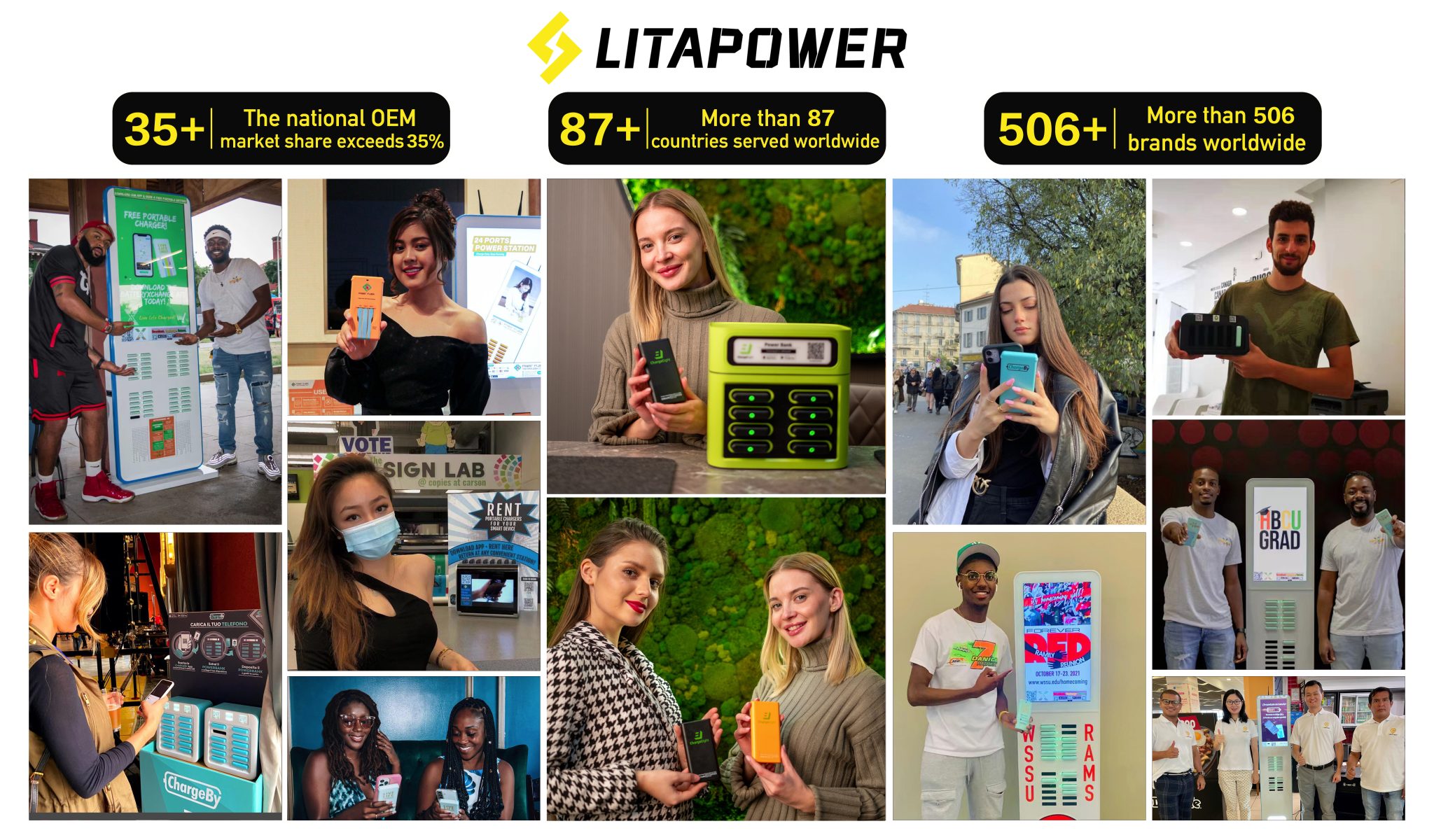
Entering the Cambodian market involves more than purchasing equipment and finding deployment locations. Operators must also address local business entities, equipment certification, payment integration, software systems, and daily maintenance. Kekuatan Litapower, the overseas brand of Zhongdian Hexin’s shared power bank manufacturing business, has served eight Southeast Asian countries and deployed more than 4,800 terminal devices. The company can provide hardware, software, and OEM/ODM brand customization support for local projects.
5.1 Choose an OEM/ODM Manufacturer with Hardware and Software Delivery Capabilities
Cambodia projects should work with shared power bank manufacturers that have stable production capabilities, overseas delivery experience, and software technical support. Zhongdian Hexin can provide shared power bank stations, power banks, rental management software, operation management systems, API interfaces, dan OEM/ODM private-label customization services, helping partners establish their own brands and independent operating systems.
For payment integration, solutions can be planned around Cambodia’s payment ecosystem, including KHQR, Bakong-related payment services, and cross-border QR code payments. If a partner already has its own software or a third-party operating system, API integration can be provided according to project requirements, avoiding the need to purchase an entirely new software platform.
For certification, the manufacturer can assist in preparing product specifications, wireless module information, technical documentation, and existing CE test reports, while coordinating with local importers and certification service providers on TRC type approval. Companies should also monitor formal regulatory developments related to the proposed 2026 certification framework and plan for potential requirements involving local representatives and compliance labels.
Project implementation requires a five-chain support system:
- Supply Chain: Ensures equipment production, quality control, component supply, and subsequent bulk delivery.
- Operations Chain: Supports independent brand operations, venue partnerships, rental rule configuration, and revenue management.
- Compliance Chain: Assists with TRC certification documentation and planning for importer and local operating requirements.
- Service Chain: Provides software training, remote technical support, equipment maintenance, and system upgrades.
- Funding Chain: Helps develop a project financial plan covering equipment purchases, venue revenue sharing, payment processing fees, and maintenance expenses.
5.2 Equipment Deployment: Prioritize Tourism and Commercial Scenarios
Before deployment, partners should confirm their local operating entity, importer documentation, payment accounts, equipment certification, and venue resources. Having a local company or a stable local operating team can help manage imports, merchant agreements, payment settlements, equipment maintenance, and daily operations.
Location expansion can be carried out through partnerships with local channel providers, hotel groups, shopping centers, restaurant brands, and tourism service providers. Revenue-sharing arrangements can be negotiated according to the foot traffic, location resources, operational support, and maintenance responsibilities provided by each venue. Operators can also deploy equipment directly through locations they already control.
For the initial stage, small-scale pilot projects are recommended. Priority locations can include attractions and hotels in Siem Reap, resort and commercial areas in Sihanoukville, tourist streets in Battambang, and riverside restaurant areas in Kampot. Operators should monitor actual rental frequency, payment success rates, equipment turnover, and venue costs before deciding on further expansion.
5.3 Management and Operations: Build a Sustainable Revenue Model
The profitability of a shared power bank business depends on equipment utilization, location quality, and operating costs—not simply the total number of devices deployed. Operators should use the management backend to monitor device connectivity, power bank inventory, orders, payment records, and revenue at each location.
Daily operations should focus on the following areas:
- Set reasonable rental prices and billing rules: Adjust pricing according to local spending levels, tourist demographics, and venue characteristics.
- Promote the local brand: Use local social media, short-form videos, tourism platforms, and commercial events to increase brand awareness.
- Review operating performance monthly: Analyze rental frequency, venue revenue sharing, payment processing fees, equipment maintenance, and operating expenses, then adjust underperforming locations.
- Monitor seasonal tourism changes: Cambodia’s traditional rainy season runs from May to October. In 2026, the government introduced the “Green Season” campaign to promote rainy-season tourism consumption (Cambodia Ministry of Tourism, 2026). Operators can adjust equipment deployment and promotional priorities according to actual changes in local visitor traffic.
Through equipment, software, and technical support, Zhongdian Hexin Litapower helps partners establish independent brand operating systems. For the Cambodia market, validating payment options and location performance before expanding equipment coverage can help control initial investment and build long-term operating capabilities.
FAQ: Frequently Asked Questions About Shared Power Bank Projects in Cambodia
Q1: How large is the shared power bank market in Cambodia?
The Cambodia shared power bank market is at an early deployment stage, with development supported by tourism consumption, mobile internet, and digital payments. Cambodia has a population of approximately 17.9 million and around 12 million internet users (DataReportal, October 2025). In 2025, the country received 5.57 million international visitors and generated approximately USD 3.7 billion in international tourism revenue (Cambodia Ministry of Tourism and National Bank of Cambodia, 2025). Operators can focus on tourism and regional commercial cities such as Siem Reap, Sihanoukville, Battambang, and Kampot.
Q2: What certifications are required to deploy shared power banks in Cambodia?
Shared power bank equipment must obtain the applicable TRC type approval according to its wireless communication functions and product structure. The current application process generally takes around 6–8 weeks, and existing CE test reports may be used as supporting documents (Cambodia TRC certification information, 2025–2026). Applicants should also prepare importer information and product technical documentation, while monitoring requirements that may follow the formal implementation of the proposed 2026 certification framework.
Q3: Which payment methods are commonly used by tourists and local residents in Cambodia?
Bakong and KHQR are important parts of Cambodia’s local digital payment infrastructure. In 2025, KHQR acceptance points reached approximately 4.5 million, while the Bakong system had around 8.5 million bank users. It has also established payment connections with China UnionPay, Alipay+, WeChat Pay, and other payment systems (National Bank of Cambodia, NBC, 2025). Shared power bank projects can prioritize KHQR, local bank payments, cross-border QR code payments, and bank card options for tourists.
Q4: How long does it take for a shared power bank project in Cambodia to recover its investment?
According to Zhongdian Hexin Litapower’s experience managing shared power bank projects in Southeast Asia, the payback period for a Cambodia project should be calculated according to location traffic, rental frequency, rental pricing, equipment investment, venue revenue sharing, payment processing fees, and maintenance costs. It is advisable to start with pilot deployments in tourist attractions, hotels, and commercial venues, review actual orders and revenue at each location monthly, and then develop an expansion plan.
Q5: What project experience do Chinese shared power bank brands have when entering Cambodia?
Zhongdian Hexin Litapower has served eight Southeast Asian countries and deployed more than 4,000 terminal devices. The company provides shared power bank hardware manufacturing, software systems, API interfaces, and OEM/ODM brand customization. When entering Cambodia, it can combine local TRC certification requirements, the Bakong and KHQR payment ecosystem, and tourism and commercial scenarios in cities such as Siem Reap and Sihanoukville to provide equipment, software, and technical support, helping partners establish independent local brand operations.
References
- DataReportal, Digital 2026: Cambodia: https://datareportal.com/reports/digital-2026-cambodia
- Cambodia Ministry of Tourism, via Xinhua News Agency: https://www.xinhuanet.com/english/asiapacific/20260127/e51a425f837746bb85ae6701497b8982/c.html
- Cambodia Ministry of Tourism, Green Season 2026, via Xinhua News