 Bank kuasa sewa,
Introduction: Why Is the UAE a High-Value Market for Shared Power Banks in the Middle East?
The UAE has highly international tourist traffic, mature commercial consumption scenarios, and a well-developed digital payment environment. For shared power bank investors planning to enter the Middle Eastern market, Dubai and Abu Dhabi represent two distinct operating opportunities: tourism and shopping in Dubai, and cultural and family-oriented consumption in Abu Dhabi.
The answer is the UAE. In 2025, Dubai welcomed 19.6 million international overnight visitors (Dubai Department of Economy and Tourism, 2025), while Dubai International Airport handled 95.2 million passengers throughout the year (Emirates News Agency, WAM, 2025). The continuous growth of international traffic creates stable potential demand and revenue opportunities for mobile charging services.
This article focuses exclusively on the UAE, examining the implementation conditions for shared power bank projects from four perspectives: three key market advantages, MOIAT ECAS and TDRA type approval, the digital payment ecosystem, and city-specific business scenarios in Dubai and Abu Dhabi.
I. UAE Shared Power Bank Market: Three Key Advantages
The UAE’s market appeal mainly comes from international tourism, mobile internet penetration, and the development of digital payments. Together, these factors establish a strong demand foundation for shared power bank projects.
Advantage 1 | Growing International Tourism
In 2025, Dubai welcomed 19.6 million international overnight visitors, representing a year-on-year increase of 5%. The average hotel occupancy rate in Dubai reached 80.7% in 2025 (Dubai Department of Economy and Tourism, 2025).
Tourists spend considerable time in shopping malls, waterfront promenades, night markets, and tourist attractions. Activities such as mobile navigation, photography, social media, and mobile payments continuously consume smartphone battery power.
Advantage 2 | Highly Developed Mobile Internet Penetration
The UAE has a population of approximately 11.4 million, with 11.3 million internet users and an internet penetration rate of 99.0%. The number of mobile connections has reached 23 million, equivalent to 202% of the population (DataReportal, 2025 data).
The number of mobile connections exceeding the population reflects the widespread use of multiple SIM cards and eSIMs. It also demonstrates the high level of dependence on mobile devices among both local residents and expatriates.
Advantage 3 | A Mature Digital Payment Ecosystem
In 2025, digital wallets accounted for 35% of UAE e-commerce payments, followed by credit cards at 27%, debit cards at 15%, and Aani bank transfers at 10% (Worldpay, 2025).
Meanwhile, Aani reached 12.5 million registered users, connected 74 financial institutions, and covered approximately 774,000 merchants (Al Etihad Payments, 2025).
These digital payment habits provide a solid foundation for QR code-based shared power bank rentals, online payment collection, and unattended operations.
The combination of tourism traffic, mobile device usage, and digital payment adoption gives the UAE a strong market foundation for developing shared power bank rental services.
II. Key City Market Analysis in the UAE
Shared power bank deployment in the UAE can focus on two major markets: Dubai and Abu Dhabi.
Dubai is primarily driven by international tourists, Pusat membeli-belah, and nighttime markets, while Abu Dhabi is more focused on cultural attractions, local families, and leisure consumption.
In 2025, Dubai welcomed 19.6 million international overnight visitors, while the five airports in Abu Dhabi handled a combined total of more than 33 million passengers (Dubai Department of Economy and Tourism and Emirates News Agency, WAM, 2025).
2.1 Dubai: International Tourism and Shopping Consumption
Dubai is one of the UAE’s most important destinations for international tourists. In 2025, Dubai International Airport handled 95.2 million passengers, representing a year-on-year increase of 3.1% (Emirates News Agency, WAM, 2025).
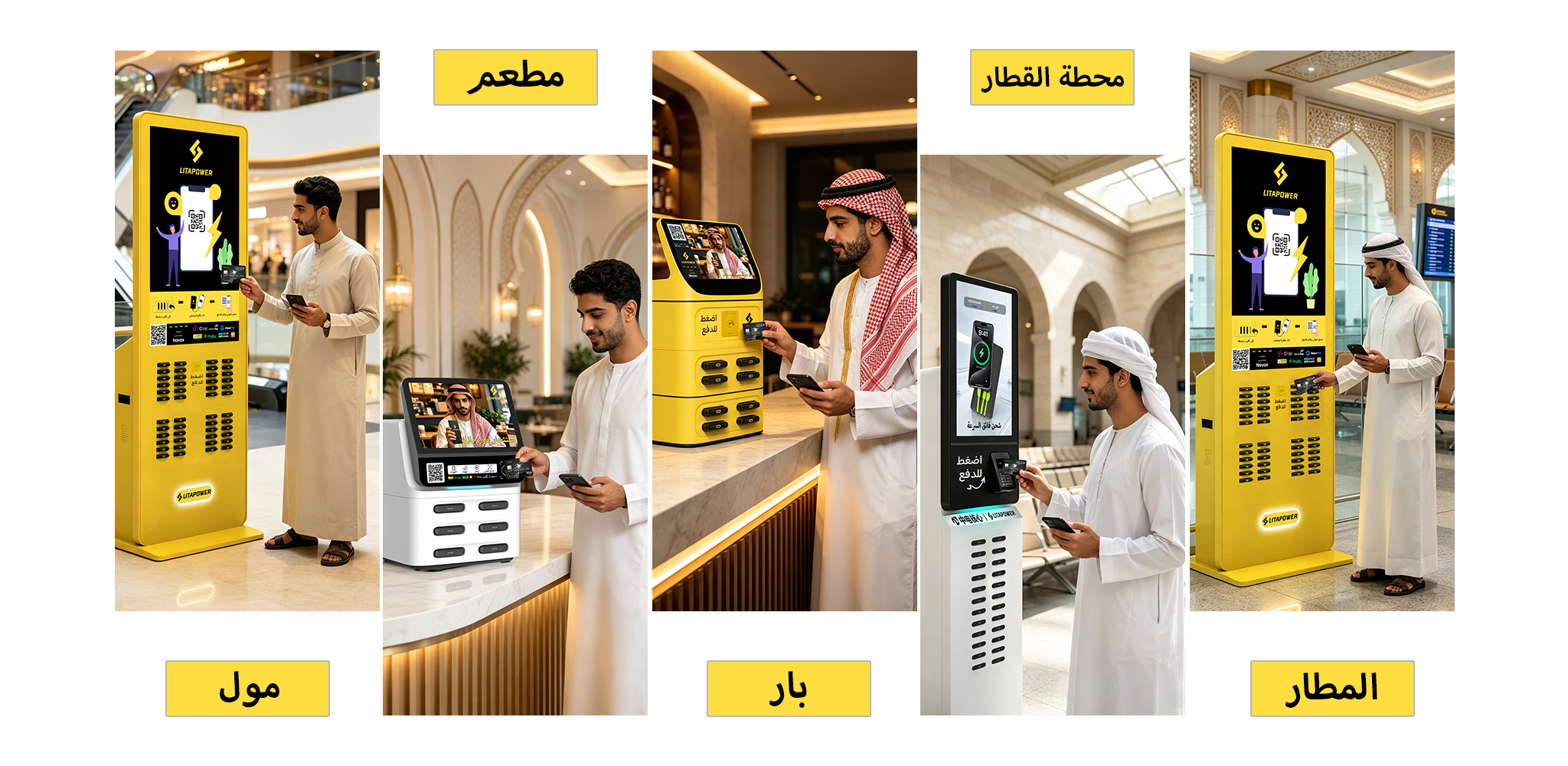
International tourists, shopping visitors, and nighttime leisure consumers together form a potential customer base for shared power bank services.
(1) Global Village + JBR Walk
Global Village is a seasonal marketplace and nighttime entertainment destination. During the 2025–2026 season, it welcomed approximately 10 million visitors. It generally operates from October to April of the following year, with daily opening hours of approximately 16:00–24:00 (Global Village official website, 2025–2026 season).
Visitors spend extended periods exploring themed pavilions, dining areas, and shopping zones. Shared power bank stations are suitable for entrances, restaurant clusters, and designated rest areas.
JBR Walk / The Beach is a waterfront pedestrian, dining, and retail destination. It is accessible throughout the day, with visitor traffic becoming more concentrated after 19:00 (Dubai Tourism, 2026).
The frequent smartphone usage of waterfront restaurant customers, retail shoppers, and nighttime pedestrians makes dining rest areas and commercial locations along the promenade suitable deployment points.
(2) Dubai Mall + Dubai Marina Walk
Dubai Mall is one of Dubai’s major shopping destinations. It generally operates from 10:00 to 24:00, with weekend hours extended until 01:00. According to the mall operator, annual visitor numbers exceed 100 million (Dubai Mall official website, 2025).
Shopping, dining, entertainment, and sightseeing activities encourage extended indoor stays, making mall entrances, restaurant areas, and leisure spaces suitable locations for shared power bank stations.
Dubai Marina Walk is a waterfront commercial and leisure district that remains accessible throughout the day. It combines residential communities, Restoran, and boat-related tourism activities (Dubai Tourism, 2026).
Local residents and expatriate visitors are particularly active in this area at night, making it a complementary deployment location connecting commercial consumption with leisure traffic.
(3) Deployment and Operations
Zhongdian Hexin’s overseas brand, Litapower, provides shared power bank software, hardware solutions, and OEM private-label customization services for international markets.
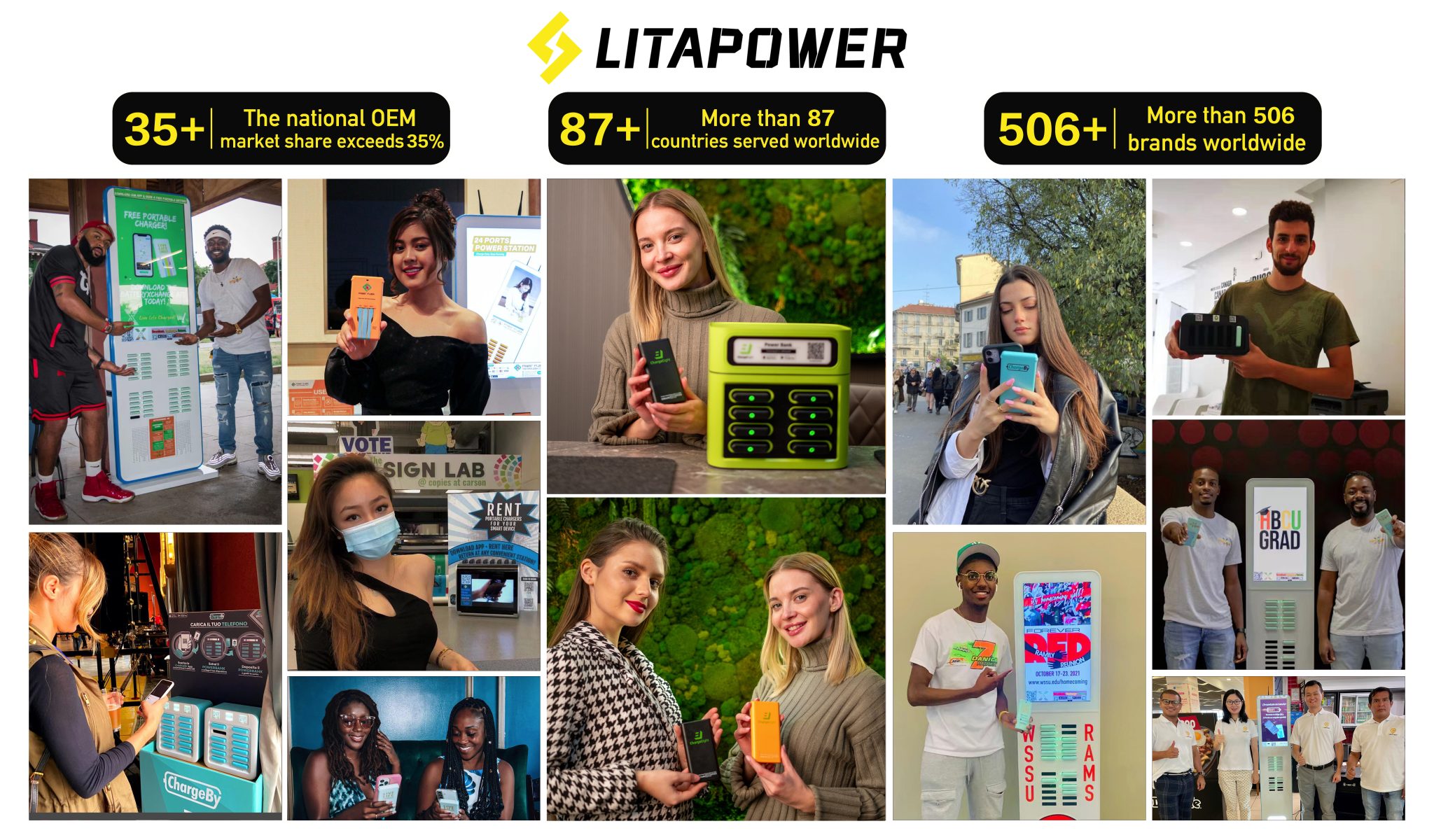
Based on its shared power bank project experience in the Middle East, the initial Dubai deployment focuses on 8-slot stations across locations such as Global Village, JBR Walk, Dubai Mall, and Dubai Marina.
Operational strategies focus on venue management, dynamic pricing, and membership promotions to improve revenue per device. Marketing activities are scheduled according to peak tourism seasons and nighttime market operating hours.
The estimated investment payback period for the Dubai project is approximately 3–7 months.
2.2 Abu Dhabi: Cultural Tourism and Family Consumption
Shared power bank applications in Abu Dhabi are more focused on family leisure, cultural visits, and landmark tourism.
In 2025, the five airports in Abu Dhabi handled a combined total of more than 33 million passengers, with Abu Dhabi International Airport accounting for approximately 98% of the total (Emirates News Agency, WAM, 2025).
Airport traffic, combined with the city’s cultural tourism destinations, provides shared power bank projects with consumption opportunities that differ from Dubai’s shopping and nighttime market scenarios.
(1) Corniche + Qasr Al Watan
Abu Dhabi Corniche features approximately 8 kilometers of waterfront promenade and is accessible throughout the day. Evening hours are particularly popular with local residents and families engaging in leisure activities (Abu Dhabi municipal information, 2026).
Walking, relaxation, and family outings along the waterfront make nearby commercial facilities and rest areas suitable locations for shared power bank stations.
Qasr Al Watan is one of Abu Dhabi’s major landmarks, with opening hours of approximately 10:00–20:00 (Qasr Al Watan official website, 2026).
Visitors continuously use their smartphones while exploring the architecture, taking photographs, and experiencing cultural activities. Shared power bank services are suitable for entrances and visitor rest areas.
(2) Yas Mall + Louvre Abu Dhabi
Yas Mall is located in the main commercial district of Yas Island. It generally operates from 10:00 to 23:00, with weekend hours extended until 24:00 (Yas Mall official website, 2026).
The mall is close to major theme park and entertainment attractions. Family shopping, dining, and leisure activities encourage extended visitor stays, making main entrances, restaurant areas, and public rest areas suitable locations for shared power bank stations.
Louvre Abu Dhabi generally operates from 10:00 to 18:30 and is closed on Mondays (Louvre Abu Dhabi official website, 2026).
Cultural visits, international tour groups, and photography activities create continuous smartphone usage demand. Shared power bank rental points are suitable for visitor service areas and designated rest spaces.
III. FAQ: UAE Shared Power Bank Market
Q1. How large is the shared power bank market in the UAE?
The demand foundation for shared power bank services in the UAE mainly comes from international tourism, mobile internet penetration, and commercial consumption.
In 2025, Dubai welcomed 19.6 million international overnight visitors, representing a year-on-year increase of 5% (Dubai Department of Economy and Tourism, 2025).
Across the UAE, the number of internet users reached 11.3 million, with an internet penetration rate of 99.0% (DataReportal, 2025 data).
According to estimates from local operators, shared power bank market penetration in the UAE is approximately 20%, with an estimated potential capacity of 10,000–15,000 stations based on mature-market benchmarks (HiDubai local industry interviews, 2025).
This estimate reflects potential industry development opportunities rather than an official government market-size statistic.
Q2. What certifications or registrations are required to deploy shared power banks in the UAE?
Shared power bank equipment in the UAE mainly involves MOIAT ECAS conformity assessment and TDRA type approval.
Portable power banks and other regulated electrical and electronic products must undergo conformity assessment in accordance with MOIAT ECAS requirements. The estimated processing period is approximately 2–4 weeks, with costs ranging from USD 800–2,000 per model.
Equipment containing Bluetooth, Wi-Fi, or cellular communication modules must obtain TDRA type approval. The estimated approval period is approximately 2–6 weeks, with costs ranging from USD 500–1,500 per model (MOIAT and TDRA, 2026).
Importers and distributors should also pay attention to TDRA Dealer Registration requirements. Offline deployment may additionally involve commercial licenses, venue consent letters, and relevant municipal permits.
Q3. What payment methods do UAE residents and tourists use to rent shared power banks?
Shared power bank operators in the UAE can support payment methods such as Visa, Mastercard, Apple Pay, and Aani.
In 2025, digital wallets accounted for 35% of UAE e-commerce payments, while credit cards represented 27% and debit cards accounted for 15% (Worldpay, 2025).
Aani reached 12.5 million registered users, connected 74 financial institutions, and covered approximately 774,000 merchants (Al Etihad Payments, 2025).
Walau bagaimanapun, Aani primarily serves users with local UAE bank accounts. International tourists are more suited to paying through bank cards and mobile wallets that support international card linking.
Q4. How can investors establish their own shared power bank brand in the UAE?
Local entrepreneurs and investors in the UAE can work with Chinese manufacturers through OEM private-label customization to establish their own brands and local operating businesses.
By integrating rental systems, backend management platforms, and payment interfaces, operators can develop their own shared power bank networks.
Zhongdian Hexin’s overseas brand, Litapower, has implemented projects across multiple international markets, including Southeast Asia, the Middle East, and Europe. It provides shared power bank hardware, software systems, and OEM private-label customization services, helping partners establish independent brands and operating systems.
Q5. How long does it take to recover the investment in a shared power bank project in the UAE?
Based on Zhongdian Hexin Litapower’s shared power bank project experience in the Middle East, the estimated investment payback period for 8-slot stations is approximately 3–8 months in Dubai and 4–6 months in Abu Dhabi.
Dubai primarily targets international tourism and shopping traffic, while Abu Dhabi focuses more on cultural tourism and family-oriented consumption.
Actual operating performance and investment recovery depend on venue partnership conditions, device usage frequency, rental pricing, and operational management efficiency.
References
- UAE Population, Internet Users, and Mobile Connections (DataReportal, 2025 data)
https://datareportal.com/reports/digital-2026-united-arab-emirates - Dubai International Overnight Visitors and Hotel Occupancy in 2025 (Dubai Department of Economy and Tourism, 2025)
https://centralbank.ae/media/lgtjq2wr/qer-march_2026.pdf - UAE E-commerce Payment Structure in 2025 (Worldpay, 2025)
https://www.worldpay.com - UAE Airport Passenger Traffic in 2025 (Emirates News Agency, WAM, 2025)
http://abudhabinews.net/news/278865549/uae-solidifies-global-leadership-in-aviation-tourism-in-2025 - MOIAT ECAS Product Conformity Requirements (MOIAT, 2026)
https://www.moiat.gov.ae/en - TDRA Wireless Device Type Approval and Dealer Registration Requirements (TDRA, 2026)
https://www.tdra.gov.ae/en - UAE Commercial Licenses and Municipal Outdoor Deployment Permits (DET, ADDED, and Local Municipal Authorities, 2026)
https://www.dubaidet.gov.ae - Global Village Seasonal Operating Hours and Visitor Statistics (Global Village, 2025–2026 season)
https://www.globalvillage.ae