 Alquiler de power bank,Fabricante de bancos de energía compartidos
Myanmar is currently at a stage of tourism market recovery and digital payment infrastructure development, providing a certain foundation for mobile charging demand. According to data from the Ministry of Hotels and Tourism of Myanmar, the country received 973,263 international tourist arrivals in 2025. The government has set a target of attracting 1.8 million international visitors in 2026 (Ministry of Hotels and Tourism of Myanmar, 2025–2026).
There are three main reasons why the Myanmar market deserves attention:
1. Market foundation: Myanmar has 39.8 million internet users, with an internet penetration rate of 72.5% (DataReportal, Digital 2026: Myanmar, October 2025).
2. Payment development: KBZPay has more than 22 million registered users and processed 380 million transactions in 2025 (Myanmar payment ecosystem research, 2025).
3. Compliance requirements: Devices equipped with Wi-Fi or Bluetooth communication functions require PTD type approval before importation or local manufacturing. Document review generally takes around 8–12 weeks (Myanmar Posts and Telecommunications Department, PTD certification materials, 2025–2026).
Sin embargo, Myanmar also faces practical challenges, including foreign exchange controls, payment settlement restrictions, and market security concerns. This article analyzes the market data, certification requirements, payment environment, city-level deployment opportunities, and project implementation solutions for entering the Myanmar shared power bank market.
I. Myanmar Shared Power Bank Market Data: 4 Key Figures
To determine whether Myanmar has the potential to support a shared power bank business, operators should look beyond population size and consider mobile internet access, tourism traffic, economic conditions, and infrastructure development.
1.1 Internet Users: 39.8 Million
According to DataReportal’s Digital 2026: Myanmar, Myanmar has a population of approximately 54.9 million, Incluido 39.8 million internet users, representing an internet penetration rate of 72.5%. The number of mobile connections has reached 62.5 million, equivalent to 114% of the population (DataReportal, Digital 2026: Myanmar, October 2025).
The number of mobile connections exceeding the population indicates that multiple-device usage exists in the local market. As smartphones become increasingly important for everyday communication, mobile payments, transportation, and social networking, users will continue to rely on portable power solutions. This provides a potential customer base for shared power bank rental services.
1.2 International Tourist Arrivals: 973,263 in 2025
According to the Ministry of Hotels and Tourism of Myanmar, the country received 973,263 international tourist arrivals in 2025. Major source markets included China, Tailandia, and South Korea, with China being an important source market for air arrivals (Ministry of Hotels and Tourism of Myanmar, 2025).
Tourism is becoming an important direction for Myanmar’s economic recovery. The government has set a target of attracting 1.8 million international tourists in 2026. In the first half of 2026, international tourist arrivals reached 530,973, representing a year-on-year increase of 6% (Ministry of Hotels and Tourism of Myanmar, 2026).
When visiting airports, Hoteles, Atracciones turísticas, restaurantes, and commercial districts, tourists typically rely on their smartphones for navigation, translation, photography, comunicación, and payments. Shared power banks can serve as an additional tourism service, providing visitors with convenient temporary charging options.
1.3 Economic Foundation: GDP of USD 81.67 Billion
According to World Bank data, Myanmar’s GDP reached USD 81.67 billion in 2025, with a GDP per capita of USD 1,489 (World Bank Open Data, 2025).
This income level means that operators need to pay close attention to local consumer purchasing power when designing their initial business models. Shared power bank rental prices should not simply follow the pricing strategies used in high-income countries. Instead, pricing should be determined by considering local consumption levels, rental duration, equipment costs, and venue revenue-sharing arrangements.
For operators, the priority should be to validate high-frequency usage scenarios, control initial equipment investment and daily operating costs, and then adjust expansion plans according to actual order data.
1.4 Yangon International Airport: Nearly 1.977 Million Passengers from January to August 2025
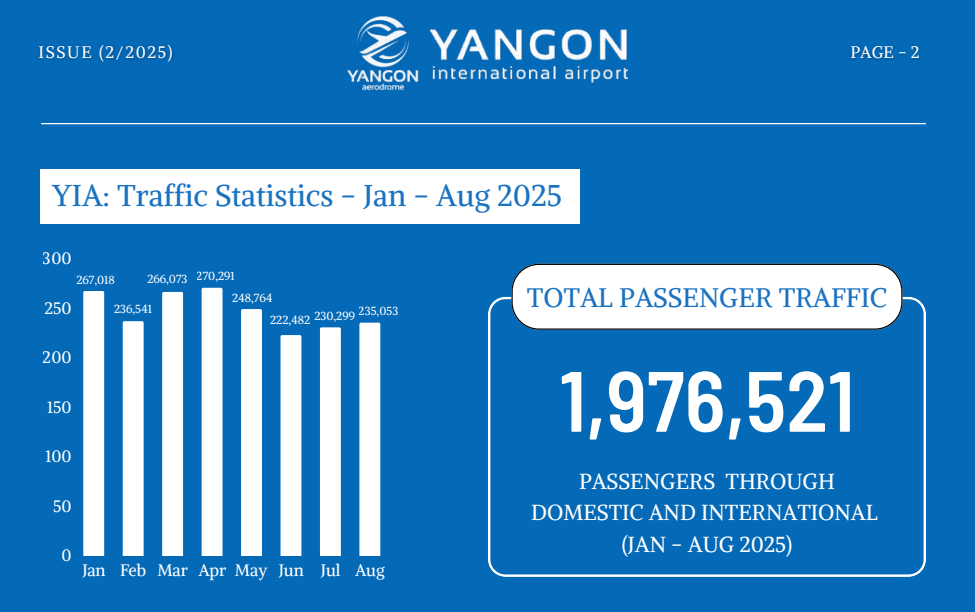
According to the newsletter published by Yangon Aerodrome Company Limited (YACL), passenger traffic at Yangon International Airport reached 1,976,521 between January and August 2025 (Yangon International Airport, YACL Newsletter, 2025).
Airports are typical deployment locations for shared power banks. Sin embargo, new operators entering the market do not necessarily need to target highly competitive major transportation hubs with relatively high partnership barriers during the initial stage. Hotels, shopping centers, areas surrounding tourist attractions, and restaurant districts are also worth considering.
II. Compliance and Certification Requirements for Shared Power Banks in Myanmar
When entering the Myanmar market, equipment certification is an important matter that must be addressed before importing and commercially deploying devices. Shared power bank stations generally contain communication modules, and whether a device supports Wi-Fi, Bluetooth, or other wireless functions directly affects its certification requirements.

2.1 PTD Type Approval: An Important Requirement for Importing Communication Equipment
Myanmar’s Posts and Telecommunications Department (PTD) operates under the Ministry of Transport and Communications (MoTC). Under the Telecommunications Law of 2013 and related regulatory requirements, telecommunications and IT equipment equipped with communication functions such as Wi-Fi and Bluetooth must obtain PTD type approval before importation or local manufacturing.
For shared power bank equipment, operators should pay particular attention to the wireless communication modules, network connectivity methods, and equipment models used in each station. They should confirm whether the specific product falls within the scope of PTD certification.
The certification application generally involves the following documents and requirements:
- Equipment technical specifications, model information, and wireless communication parameters.
- Product test reports and relevant technical documentation.
- Manufacturer information, applicant details, and information about the authorized local representative in Myanmar.
- Equipment labels and PTD certificate number requirements.
2.2 Certification Timeline and Test Report Requirements
According to relevant PTD certification materials, document review generally takes around 8–12 weeks. If local sample testing is required, an additional 2–3 weeks may be necessary. Certificates are valid for 1–5 years, depending on the conditions specified when the certificate is issued (Myanmar PTD certification materials, 2025–2026).
One particularly important requirement is that the test report submitted with the application must have been issued within the previous two years.
This means that even if equipment already has CE, FCC, or other international standard test reports, applicants must check the report issuance date, corresponding product model, and technical specifications in advance to ensure they meet PTD application requirements.
PTD application documents may be prepared using test reports based on international standards such as ETSI, FCC, CE, and CCC. Sin embargo, obtaining any one of these international certifications does not automatically replace Myanmar’s PTD type approval.
2.3 Choosing Between Certification Agencies and Independent Applications
For operators entering Myanmar for the first time, certification involves multiple procedures, including technical documentation, local authorized representatives, application processes, and equipment labeling.
Applying independently allows project operators to maintain direct control over the application process, but requires local compliance resources and the ability to prepare technical documents.
Working with experienced testing or certification service providers can help reduce repeated communication and document preparation. Before cooperation, project operators should confirm the scope of services, testing items, official charges, and third-party service fees to avoid mistaking a service quotation for a standardized government fee.
III. Payment and Localization Requirements for Shared Power Banks in Myanmar
Payment methods directly influence the rental experience of shared power bank users. Myanmar’s payment environment includes mobile wallets, unified QR codes, and cash payments. Operators need to plan their payment options according to actual local user habits.

3.1 KBZPay and Wave Money Are Important Mobile Payment Options
According to Myanmar payment ecosystem research, KBZPay has more than 22 million registered users and processed 380 million transactions in 2025, representing a year-on-year increase of 81%. Wave Money has more than 20 million registered users and maintains extensive coverage in rural areas (Myanmar payment ecosystem research, 2025).
KBZPay has a substantial user base, while Wave Money serves mobile payment needs across different regions. For shared power bank operators, the equipment payment system should consider the integration requirements of major local wallets rather than relying exclusively on international bank cards.
3.2 MMQR Unified QR Codes Make Merchant Payments More Convenient
The unified QR code system MMQR (MyanmarPay), promoted by the Central Bank of Myanmar, has been used for merchant payments since March 2025. A single QR code can support payments from multiple mobile wallets (Myanmar payment ecosystem research, 2025).
This provides a new foundation for integrating local payment methods into shared power bank equipment. Operators can evaluate rental payment solutions through MMQR or local mobile wallets based on merchant registration requirements, API availability, and settlement conditions imposed by local payment service providers.
It is important to note that cash and cash-on-delivery payment habits remain prevalent in Myanmar, while bank account penetration is approximately 30% (Myanmar payment ecosystem research, 2025–2026). Por lo tanto, during the initial project stage, operators should prioritize identifying the payment wallets commonly used by customers at target locations and retain payment options suitable for the local market.
3.3 Foreign Exchange and Settlement Risks Require Advance Planning
Myanmar’s payment environment involves more than consumer transactions. It also affects equipment imports, software services, cross-border procurement, and the settlement of project revenues.
The country faces foreign exchange allocation restrictions and dual exchange rate arrangements. The Financial Action Task Force (FATF) also continues to review financial risks associated with Myanmar (Myanmar payment ecosystem research and FATF-related developments, 2026).
Before investing in equipment, operators should confirm the local company structure, merchant accounts, payment service provider partnership requirements, and the feasibility of cross-border fund settlement.
The ability of consumers to scan QR codes and make payments alone should not be considered sufficient evidence that a project has established a complete commercial operating cycle.
3.4 Power Plugs, Voltage, and Equipment Power Supply Design
Common plug types in Myanmar include Type C, D, F, and G. The standard power supply is 230V at 50Hz (power-plugs-sockets.com / handypowercord, general reference).
Due to electricity supply shortages and frequent power outages in some areas, operators need to consider power supply stability when deploying equipment. For hotels, commercial venues, and tourist attractions, plug types, electrical wiring, and backup power availability should be checked in advance.
The power adapters used in shared power bank stations must meet local voltage and frequency requirements. Suitable power interfaces should also be selected according to the deployment environment.
In areas with unstable electricity supplies, operators should additionally evaluate whether equipment communication, rental records, and payment orders can recover properly after a power interruption.
IV. Key Cities and Deployment Locations for Shared Power Banks in Myanmar
During the initial market entry stage, operators should not limit their deployment plans to major cities such as Yangon. Mandalay, Bagan, Taunggyi, and Mawlamyine have different tourism, commercial, and transportation characteristics and can be considered as potential regional markets.
4.1 Mandalay and Bagan: Cultural Tourism and Hotel Service Markets
Mandalay is an important cultural city in central Myanmar and a major center for land transportation and commercial activities. Following the 2025 earthquake, the city has continued reconstruction and restoration efforts, while hotel, commercial, and tourism services are gradually recovering.
For shared power bank operators, priority should be given to hotels, restaurant clusters, shopping areas, and transportation transfer locations.
Key deployment locations: Areas surrounding Mandalay Palace and Mandalay Hill, hotel clusters, commercial streets, and restaurants and entertainment venues.
Equipment should preferably be installed in locations with stable customer traffic, reliable electricity access, and business owners willing to establish venue partnerships.
Bagan is one of Myanmar’s most representative World Heritage tourism destinations and an important area promoted by the government. Its pagoda complexes, sightseeing routes, and hotel accommodation resources create opportunities for outdoor tourism services and longer visitor stays.
Key deployment locations: Areas surrounding the Bagan Archaeological Zone, hotels and resorts, tourist service centers, attraction entrances, restaurant areas, and tourism transportation transfer points.
During sightseeing activities, visitors frequently use their smartphones for navigation, photography, and communication. Mobile charging services can therefore become part of the supporting tourism infrastructure.
4.2 Taunggyi and Mawlamyine: Resort Tourism and Regional Commercial Markets
Taunggyi and the Inle Lake region offer highland lake scenery, natural landscapes, and resort tourism resources. They are among Myanmar’s important tourism destinations promoted by the government.
Visitors may spend more than a short period sightseeing in these areas. Hotels, resorts, and tourism routes can provide opportunities for shared power bank services.
Key deployment locations: Taunggyi’s commercial districts, hotels around Inle Lake, resorts, restaurantes, tourist gathering points, and tourism service areas.
As some tourist locations are relatively scattered, operators should first evaluate the actual costs of equipment charging, inspection, and maintenance before determining deployment density.
Mawlamyine is the capital of Mon State and features a colonial-style old town, regional commercial activities, and border trade connections. Compared with traditional major tourism cities, it can serve as a potential location for exploring regional market opportunities.
Key deployment locations: Mawlamyine’s old town, riverside commercial areas, Hoteles, restaurant streets, shopping locations, and transportation hubs.
Operators can first establish partnerships with local merchants and test user demand with a limited number of devices before gradually expanding coverage.
V. Zhongdian Hexin’s Myanmar Market Entry Solutions: Project Implementation
A shared power bank project in Myanmar requires more than equipment procurement. Operators must also address certification, payment integration, venue partnerships, software systems, and long-term operations.
For operators entering the local market for the first time, a small-scale pilot project followed by commercial validation and gradual expansion is recommended.
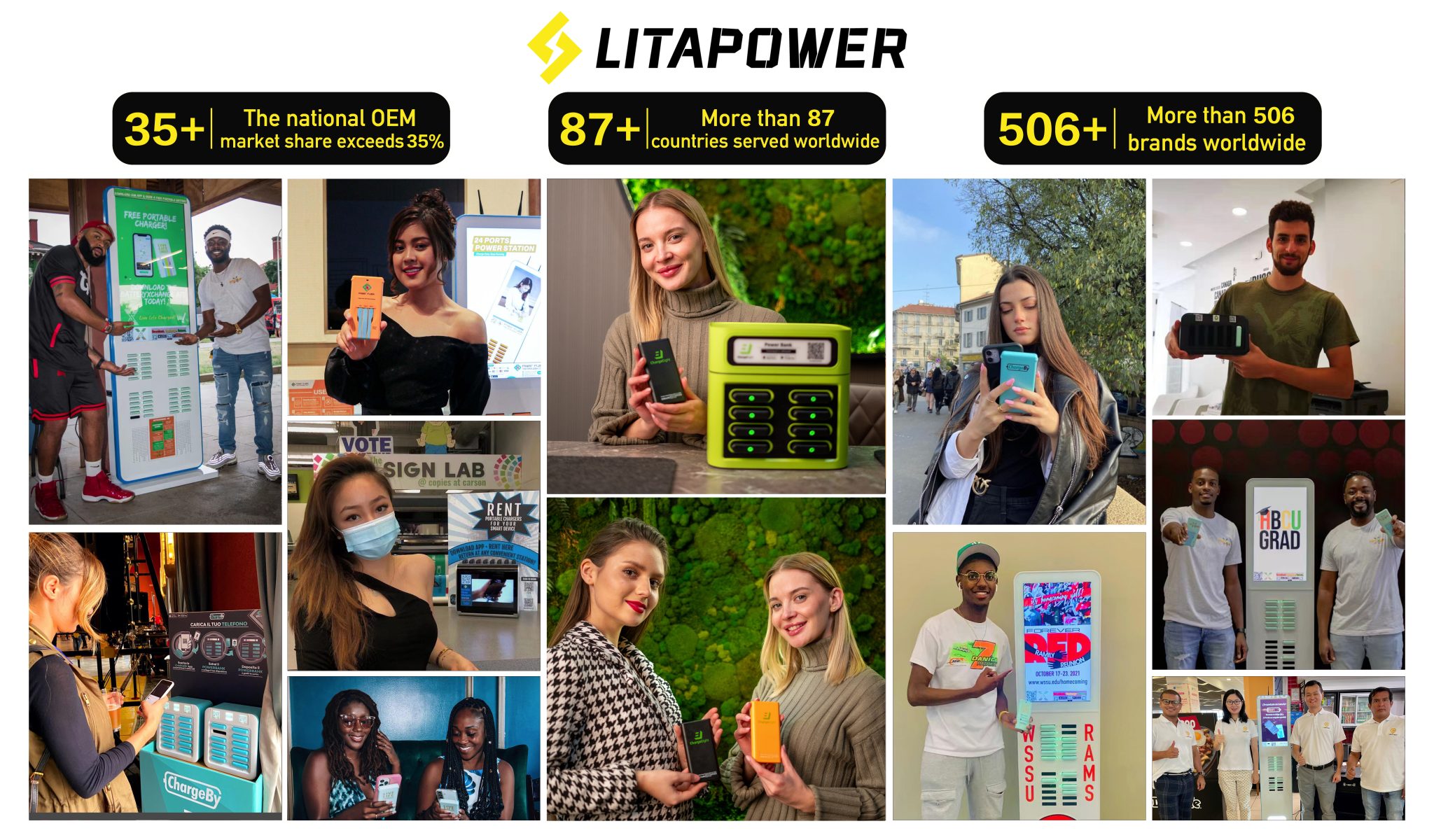
Litapower, the overseas brand of Zhongdian Hexin, a shared power bank manufacturer, has served eight Southeast Asian countries and deployed more than 4,000 terminal devices in the region.
For the Myanmar market, project planning can focus on the following areas.
5.1 Choose the Right OEM/ODM Hardware and Software Supplier
A shared power bank project involves station hardware, Bancos de energía, battery management, rental software, payment integration, and an operations management backend.
Choosing a supplier with both hardware manufacturing and software development capabilities can help reduce compatibility issues between equipment and management systems.
Litapower can provide shared power bank hardware, rental software, operations management systems, and OEM/ODM private-label customization services according to project requirements.
For customers who already have their own software development teams or independent operating systems, API access and technical integration support can also be provided according to their actual requirements.
Before officially importing equipment into Myanmar, the project operator must confirm PTD certification requirements based on the communication modules used in the equipment and check whether the test reports meet the requirement of being issued within the previous two years.
For local payment methods such as KBZPay, Wave Money, and MMQR, integration should be planned according to local merchant registration, payment service provider API availability, and approval conditions.
Payment functions should not be considered operational before actual testing and merchant approval have been completed.
Zhongdian Hexin’s shared power bank equipment adopts a dual-locking design with two locking points, improving the stability of power banks inside the station and reducing the risk of devices falling out or being stolen.
Depending on the project environment, equipment can also be configured with appropriate protection features to meet the requirements of different commercial venues and outdoor deployment locations.
5.2 Equipment Deployment: Prioritize Locations with Sustainable Operating Potential
For the Myanmar market, operators are advised to start with hotels, commercial districts, Atracciones turísticas, and restaurants.
Project operators can obtain deployment locations through local channel partnerships, venue cooperation, and independent business development.
The following scenarios can be prioritized during the initial stage:
- Tourism locations: Hotels, resorts, attraction entrances, and tourist service centers.
- Commercial locations: Shopping venues, restaurant streets, Centros comerciales, and entertainment areas.
- Transportation locations: Areas around airports, transportation transfer points, and urban transportation hubs.
Partnership arrangements can be negotiated according to equipment investment, venue resources, daily operations and maintenance, and order revenue. Clear revenue-sharing and equipment management mechanisms should be established.
For cities where user demand has not yet been validated, operators should avoid large-scale deployment from the beginning. Instead, they should test rental frequency and user payment habits with a limited number of devices.
5.3 Operations Management: Validate Data Before Expanding
After a project goes live, operators need to continuously monitor equipment online status, power bank inventory, rental orders, returns, payment records, and revenue generated by each location through the management backend.
For projects operating across multiple cities, equipment inspection, fault handling, and power bank replenishment procedures should also be established.
Brand promotion can be combined with local social media platforms, travel content creators, joint merchant promotions, and offline marketing activities to increase public awareness of shared power bank services.
Myanmar’s GDP per capita is USD 1,489 (World Bank Open Data, 2025). Por lo tanto, rental prices should be determined according to local purchasing power.
Operators should analyze monthly order volumes, rental durations, payment processing fees, venue revenue-sharing costs, equipment maintenance expenses, and exchange rate fluctuations across different locations. Pricing and equipment distribution should then be adjusted accordingly.
The initial equipment investment should be determined based on actual venue availability, equipment costs, operational team capabilities, and payment integration progress.
Completing a pilot project before expanding equipment quantities is a more reliable approach than pursuing deployment scale alone.
FAQ: Frequently Asked Questions About Shared Power Bank Projects in Myanmar
1. How Large Is the Shared Power Bank Market in Myanmar?
Myanmar’s shared power bank market is still at an early stage of exploration. Actualmente, potential demand is better assessed through mobile internet access, tourism development, and payment infrastructure.
Myanmar has a population of approximately 54.9 million, Incluido 39.8 million internet users, with an internet penetration rate of 72.5% (DataReportal, Digital 2026: Myanmar, October 2025).
The country also received 973,263 international tourist arrivals in 2025 (Ministry of Hotels and Tourism of Myanmar, 2025).
Además, frequent power outages create practical demand for mobile charging services. These conditions make the market suitable for validating business models through regional pilot projects.
2. What Certifications Are Required to Deploy Shared Power Banks in Myanmar?
Shared power bank stations equipped with communication functions such as Wi-Fi and Bluetooth need to have their PTD type approval requirements confirmed.
PTD certification document review generally takes around 8–12 weeks. If local sample testing is required, an additional 2–3 weeks may be necessary.
Test reports must have been issued within the previous two years, and a local authorized representative in Myanmar is required (Myanmar PTD certification materials, 2025–2026).
Test reports related to CE, FCC, ETSI, or CCC can be used as supporting application documents, but they cannot directly replace PTD certification.
3. What Payment Methods Are Commonly Used by Tourists and Local Residents in Myanmar?
Major mobile payment options in Myanmar include KBZPay, Wave Money, and the MMQR unified QR code system.
KBZPay has more than 22 million registered users and processed 380 million transactions in 2025. Wave Money has more than 20 million registered users (Myanmar payment ecosystem research, 2025).
MMQR has been used for merchant payments since March 2025, allowing one QR code to support payments from multiple mobile wallets (Myanmar payment ecosystem research, 2025).
Shared power bank operators can plan payment integration according to local merchant registration requirements and the available interfaces of payment service providers.
4. How Long Does It Take to Recover the Investment in a Myanmar Shared Power Bank Project?
Based on Zhongdian Hexin Litapower’s experience with shared power bank projects in Southeast Asia, the Myanmar project should first use pilot operating data to evaluate its investment recovery period.
The estimated payback period for a Myanmar shared power bank project is approximately 4–6 months.
The calculation should take into account equipment procurement and import costs, PTD certification expenses, venue rental or revenue-sharing costs, rental pricing, order frequency, payment processing fees, operating and maintenance expenses, and exchange rate calculations.
References
- DataReportal, Digital 2026: Myanmar.
https://datareportal.com/reports/digital-2026-myanmar - Myanmar Ministry of Hotels and Tourism international tourist arrival data (Xinhua).
https://www.news.cn/english/20260122/56af582081ff4431af12e9a9949c85a4/c.html - Myanmar tourism recovery and visa policy developments (The Star).
https://www.thestar.com.my/lifestyle/travel/2026/07/20/slowly-making-a-comeback-myanmar-to-ease-visa-rules-to-attract-tourists - KIRA Research, Myanmar Payments, FX and Remittances: Trends and Outlook 2026 – Executive Summary.
https://kiraresearch.com/zh/insights/myanmar-payments-fx-and-remittances-trends-and-outlook-2026-exec-summary - Myanmar PTD type approval requirements and application documents (Huayu Testing).
https://www.huayutest.com.cn/xinwendongtai/220906.html - Southeast Asian plug types and voltage standards.
https://www.handypowercord.com/news/southeast-asia-plug-types-and-voltage-standards - Yangon International Airport, YACL Newsletter (May–August 2025).
https://www.yangonairport.aero/images/pdf/YIA_Newsletter_May_-_Aug_2025.pdf - World Bank Open Data: Myanmar GDP.
https://api.worldbank.org/v2/country/MMR/indicator/NY.GDP.MKTP.CD?format=json&mrnev=1